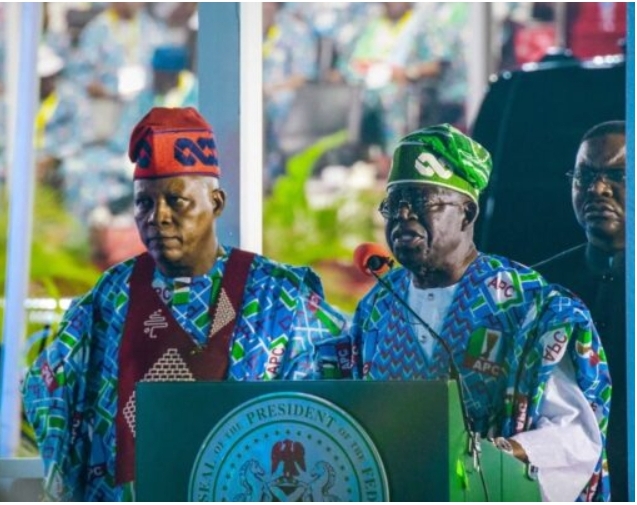
President Bola Tinubu has pledged to maintain Nigeria’s trajectory of fiscal stability and infrastructure expansion, citing a 400% Eurobond oversubscription and the new 1,600MW Grid Asset Management Company (GAMCO) initiative as evidence of returning investor confidence. Speaking at the APC’s 4th Elective National Convention in Abuja on Friday night, the President assured the business community that current sacrifices in subsidy removal and exchange rate management are foundational to long-term prosperity.
Speaking further, the President described the Convention gathering as a “defining chapter” in the history of the party and Nigeria’s democracy. He called on newly elected leaders to prioritise fairness and unity to strengthen the political organisation.
“As a party, this convention offers us the platform to renew our bond, strengthen our resolve, and recommit ourselves to the ideals that brought us together in the first place,” Tinubu said. He recalled the party’s emergence 13 years ago when patriots set aside differences for “national redemption”.
Vision and discipline as anchors for leadership
Founded in 2013, the APC was built on the shared belief that leadership must be anchored in vision, discipline, justice, and development. The president expressed deep appreciation for the founding members, women, and youth whose “sweat, courage, and conviction” changed the country’s political landscape.
Addressing the new leadership, Tinubu charged them to carry their trust with unwavering commitment. “The future of the APC and Nigeria’s democracy depends on your leadership. Lead with courage, lead with integrity, and lead with vision,” he said.
Strengthening party structures through transparency
The president noted the party’s significant growth over the past two years, citing an “unprecedented number” of new members, including governors and legislators, joining from opposition parties. He attributed this expansion to a growing trust in the APC’s core beliefs.
To sustain this momentum, Tinubu urged the leadership to maintain a “reliable, verifiable database” of members nationwide. He also led a moment of silence for the party’s first elected president, the late Muhammadu Buhari.
Tinubu warned that political parties often falter when ego overrides ideology or when individual ambition replaces discipline. He emphasised that the APC was founded as a vehicle for national transformation, aimed at building a Nigeria where institutions function and poverty declines.
Reiterating his commitment to democracy, the president clarified that his administration does not seek a one-party state. He stated that statecraft improves through “vibrant and healthy competition” and a credible opposition that can refine policies.
Electoral reforms and constitutional integrity
Addressing the Electoral Act 2026, Tinubu dismissed criticisms from opposition groups as a “disservice to the Nigerian people”. He noted that the amendment process involved extensive legislative scrutiny and public hearings in accordance with the 1999 constitution.
READ ALSO Court Faults El-Rufai’s N1bn Rights Suit Against ICPC, IGP, Others
The president reaffirmed his administration’s commitment to the rule of law and the protection of electoral integrity. He vowed to continue building a secure and united nation while upholding the sanctity of the democratic process.
Economic recovery and fiscal stability
On the economy, Tinubu acknowledged that the path to reform is difficult but necessary for long-term prosperity. He defended the removal of wasteful subsidies, stating that no economy grows by sustaining dysfunctional priorities.
Key economic indicators show signs of recovery, with GDP growing and a trade surplus recorded. Inflation has declined for eight consecutive months to 14.45%, and business confidence has expanded for 12 straight months.
Infrastructure and investment outlook
The administration has made progress in modernising seaports, airports, and road networks, though some gains face pressure from the Middle East crisis. Significant tax reforms and fiscal policy measures are being implemented to protect the economy against external shocks.
Investor confidence has improved, particularly in the oil and gas sector. Nigeria’s Eurobond issuance was oversubscribed by 400%, and the country has exited the FATF grey list. To address legacy power issues, the government plans to establish the Grid Asset Management Company (GAMCO) to inject 1,600 megawatts into the national grid.