A wave of displacement driven by persistent insecurity has forced some residents in Benue State to take refuge in schools. This story examines their living conditions and how the conversion of schools into IDP camps has led to overcrowding and disrupted education.
Sukpu Tony now sleeps in a classroom at the RCM Primary School in Agagbe, Benue State. It is one of many buildings across the state where spaces meant for learning have been turned into shelters for victims displaced by violence. At night, his family spreads out on the bare floor inside the classroom. By day, the same school premises are expected to serve as a place of learning.
The 40-year-old farmer ended up in school turned IDP camp after surviving a brutal attack on his village, Mbapupuu, in Gwer West Local Government Area. Gunmen, suspected to be armed herders, raided the community, killing several residents, including members of his family, and leaving him with a life-altering injury after his leg was cut. Believing he was dead, the attackers abandoned him.
He lay there until a passerby found him, still alive. The stranger carried him to safety, and he was later taken to Makurdi for treatment. By the time he recovered, the life he once knew had already slipped away.
Today, he lives with his family at the primary school in Agagbe. The buildings are in poor condition, with damaged roofs, no windows, and families sleeping on bare floors without bedding.
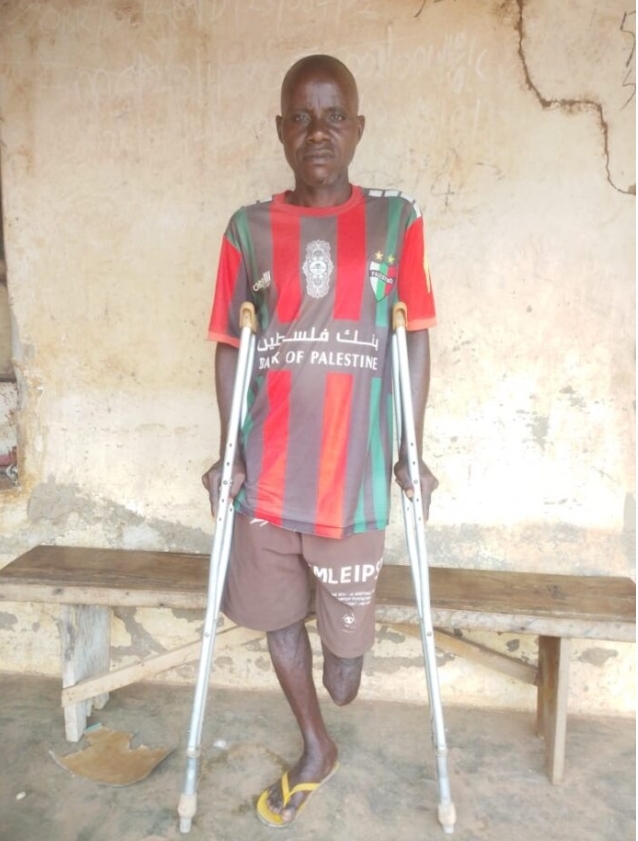
Sukpu Tony
For years, Benue has been one of the epicentres of brutal violence in north-central Nigeria, marked by systematic killings, mass displacement, and the destruction of entire communities.
The victims are largely agrarian communities, whose livelihoods have been shattered by incessant attacks primarily from armed herders.
What began as resource-based disputes over land and water access has transformed into large-scale criminal violence, underpinned by climate pressures, rapid population growth, ethnic-religious tensions, and, more importantly, state failure.
According to the International Organization for Migration (IOM), 219,477 individuals from 59,268 households had been displaced in Benue as of February 2026. Of these, 44 per cent are male and 56 per cent female. The actual figure may be higher, as not all displaced persons are registered.
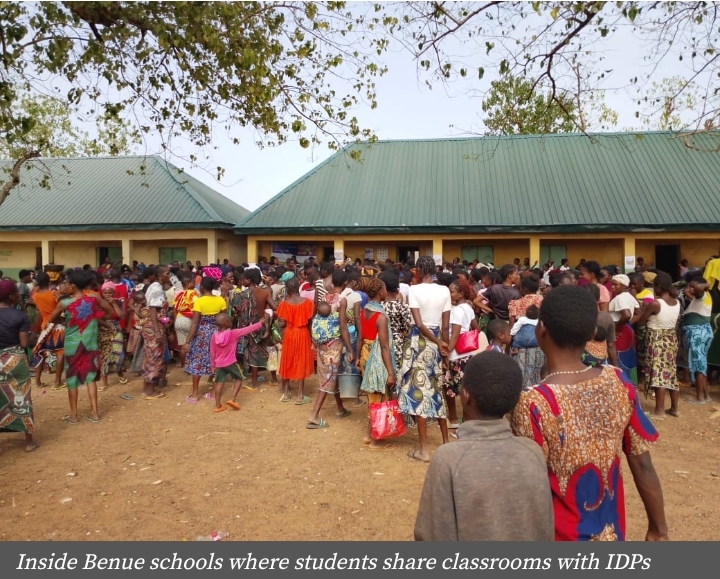
In Agagbe alone, about 2,652 individuals across 682 households are living at RCM Primary School, where Tony lives. The camp is one of several makeshift shelters across the state.
Between classroom and IDP camp
There are several sites housing internally displaced persons in Agagbe. Two of them are schools, namely RCM Primary School and St. Francis Xavier Secondary School, while the others include the Holy Rosary Camp, an abandoned police station, among others.
When this reporter visited the camp in March, the schools were on holiday, making it difficult to observe how learning takes place alongside displacement. However, a source familiar with daily operations at the camp described how the system operates when the students are in school.
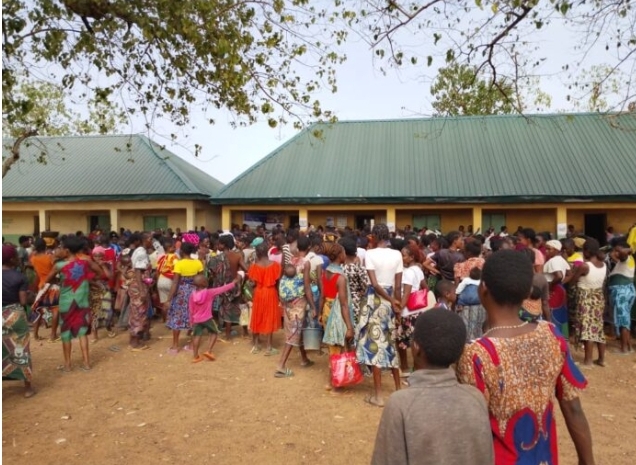
Crowded RCM Primary School
At the RCM Primary School, which serves as the central camp hub, classrooms have been divided between pupils and displaced families. Some rooms are allocated to IDPs, while others are squeezed to accommodate students. Even at that, the available space is not enough.
According to him, the school originally had about eight classrooms in use, but the number is now inadequate for the growing population. Some pupils are forced to stay outside during lessons, while others cannot attend school at all because there is no space to accommodate them.
Across other locations like St. Francis Xavier Secondary School, the situation is similar, with buildings filled beyond capacity. The Rosary’s camp and the abandoned police station also house displaced families, all relying on the same limited infrastructure.
Sanitation facilities are scarce. While Médecins Sans Frontières (MSF) constructed toilets at the RCM Primary School and St. Francis, some sites have none, forcing residents to resort to open defecation.
Water remains a major challenge. The entire community depends on a nearby stream, which is also used by cattle.
“You can even smell the cattle urine in the water,” he said, describing how humans and livestock rely on the same source.
Despite these conditions, there is no alternative supply. During dry periods, the stream reduces significantly, making access even more difficult. Some residents also fear going to fetch water due to the presence of armed men spotted around the area.
The overlap between living spaces and learning environments continues to create tension. School activities are frequently disrupted, especially when visitors arrive at the camp.
“Anytime visitors come, everything becomes disorganised. Sometimes they even close the school for that day,” he said.
Squashed inside classrooms
For Tony and many others, survival is now a daily struggle.
Putting food on the table for his family and meeting other basic needs has become an everyday struggle for him. Survival in the camp depends largely on chance and the occasional help from outsiders, which rarely comes.
The structure, originally meant for learning, offers little protection. Its roof is partly broken, the windows are missing, and the floor is bare—conditions that have left his children constantly ill.
Water is fetched from a nearby stream that is also used by herders and their livestock. With no alternative source, residents drink from the same contaminated water, exposing themselves to disease.
“We use the same stream with cows. They drink and defecate there, but we have no other option,” he said.
Cooking is equally difficult. With little access to firewood and no proper utensils, preparing meals has become an irregular activity for many families in the camp.
For Tony, displacement is not new. He was first forced out of his home in 2001 and returned in 2002. But the latest wave of violence has made any return impossible. Without relatives in safer areas or the means to rebuild, he remains stuck in the camp with his family.
His wife’s condition further complicates his situation. She has been blind for nearly three years, with no access to medical care or support.
“My wife is blind. There is nowhere to take her for treatment, and nobody is helping us,” he said.
Beyond survival, the disruption to education weighs heavily on families. The same classrooms used as shelters double as learning spaces. Whenever visitors arrive at the camp, lessons are suspended, leaving children without consistent schooling.
“When people come to visit, the children go outside to see what is happening, and teaching stops,” he explained.
With no hospital, limited food, unsafe water, and inadequate shelter, daily life in the camp is marked by hardship. For Tony and many others, the need for help is urgent.
“We are suffering. There is no food, no hospital, nothing,” he said. “They should come and help us because we are living in very bad conditions.”
Gyegu Helen, a mother of five who also lives at the camp, was displaced from Tse Adekule in Gwer West after a violent attack that claimed the lives of her husband and several relatives. She was inside one of the classrooms she now shares with her children when this reporter visited the camp.
Life in the camp, she said, is a daily struggle.
“This is how we are living here. The place is too congested, and our children are always falling sick,” she said, pointing at the crowded classroom where families sleep side by side on the bare floor.