BREAKING: Court Affirms INEC’s Constitutional Power To Issue Election Timelines, Guidelines
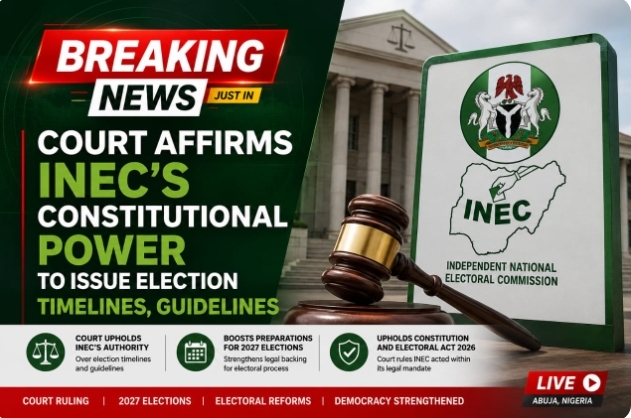
Less than 24 hours after the Independent National Electoral Commission (INEC) filed an appeal against a judgment that nullified portions of its election guidelines issued to political parties, another Federal High Court has reaffirmed the Commission’s constitutional authority to regulate electoral processes and issue timelines for elections.
In a landmark judgment delivered on Monday, May 26, 2026, Justice James Omotosho of the Federal High Court, Abuja, upheld INEC’s power to fix and prescribe timetables for the conduct of political party primaries ahead of the 2027 general elections.
The ruling came following a suit instituted by the Social Democratic Party (SDP), which challenged the electoral body’s authority to issue election schedules and guidelines binding on political parties.
The SDP, in the suit filed on April 9, 2026, presented five constitutional questions for determination and sought seven reliefs through its originating summons, arguing that INEC lacked the legal powers to dictate timelines for party primaries.
However, counsel to INEC, Dr. Alex A. Izinyon, SAN, urged the court to dismiss the suit, contending that the action was statute-barred and devoid of merit.
He further argued that INEC derives its powers from the Constitution of the Federal Republic of Nigeria, the Electoral Act 2026, as well as several binding precedents established by both the Court of Appeal and the Supreme Court.
According to the defence, the electoral commission acted fully within its constitutional mandate when it released the timetable and schedule of activities for the 2027 general elections.
In his judgment, Justice Omotosho dismissed the SDP’s arguments and affirmed that INEC possesses the constitutional and statutory authority to regulate electoral timelines and supervise the conduct of elections in Nigeria.
The ruling is expected to strengthen INEC’s regulatory powers ahead of the 2027 electoral cycle and may shape future legal interpretations concerning the relationship between political parties and the electoral umpire.
The development also comes amid increasing legal and political debates surrounding electoral reforms, party primaries, and the implementation of the Electoral Act 2026.
Read Also 2027 Election: Amend Time-table to Comply with Electoral Act, Court Orders INEC