Latest estimates by the International Labour Organisation (ILO) indicate that under a prolonged oil-shock scenario, global hour work could fall by 14 million jobs this year and 38 million next year.
The scenarios could potentially cost labour income losses reaching $3 trillion by 2027.
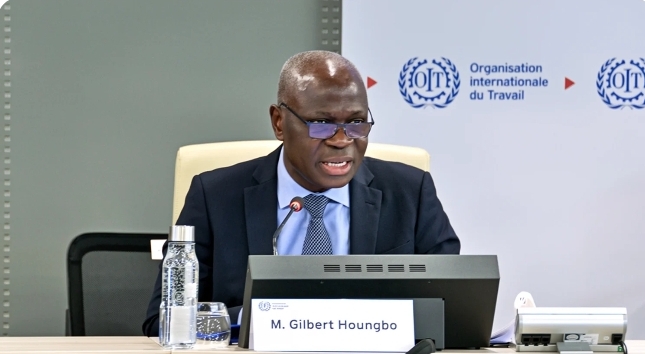
Director-General of the ILO, Gilbert Houngbo, gave the statistics in his opening speech at the ongoing 114th International Labour Conference (ILC) holding in Geneva.
The ILO urged governments and stakeholders to place people at the centre of AI revolution, stressing that the future of work will depend not only on technological advances, but on the policies, institutions and social dialogue that shape their impact on people’s lives, especially in a time of growing global uncertainty.
Drawing on the findings of his report to the conference, ‘A Moment of Choice: Harnessing Artificial Intelligence for Decent Work’, the Director-General called for a human-centred approach to AI and highlighted a strategic agenda built around four pillars: rights, employment and skills, social protection and social dialogue.
Houngbo stressed that workers everywhere must benefit from the productivity gains generated by AI.
“Those gains must be distributed fairly through better wages, stronger labour protections and more inclusive growth,” he said, adding that “collective bargaining will be essential, alongside AI governance grounded in transparency, accountability and human oversight.
The choices we make today will determine whether AI broadens opportunity and shared prosperity or deepens inequality and insecurity”, he emphasised.
The ILO chief placed the challenges in the context of a global economy facing growing uncertainty and multiple pressures on jobs and livelihoods.
“We meet at a time of profound uncertainty. The global economy remains fragile, and the crisis in the Middle East has emerged as a major source of risk for workers, enterprises and communities.
“Seafarers in the Strait of Hormuz, migrant workers in Gulf countries, agricultural workers in southern Lebanon and workers and enterprises across several sectors in Iran are among those most directly affected,” he said.
The ILO’s annual conference brings together worker, employer, and government delegates from the Organisation’s 187 Member States to address a wide range of issues with long-term impact on the world of work.