Argentina Football Association president Claudio Tapia paid a glowing tribute to captain Lionel Messi for his outstanding contribution to the national team.
Defending champions Argentina fell 1-0 in extra time to Spain in Sunday’s final in New Jersey.
Messi, who became on Sunday the first player to start three World Cup finals, was unable to deliver against Spain having previously shone with eight goals and four assists in this tournament.
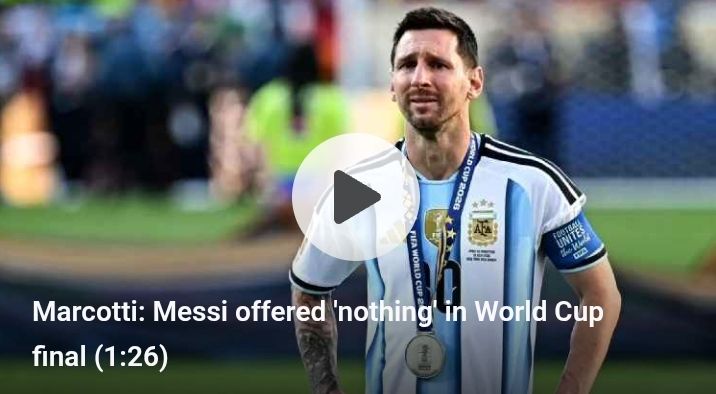
Tapia posted a photograph of an emotional Messi standing on the MetLife Stadium pitch after receiving the runners-up medal and wrote: “A story that will live forever. There are no words in the dictionary that can adequately express our gratitude for everything you gave us, captain. For your football, for your unwavering leadership both on and off the pitch, and for teaching an entire nation to dream and to fight with their hearts on their sleeves right up to the very last second.”
Messi, 39, did not stop to speak to reporters when he left the MetLife Stadium after earning his 205th cap for the Albiceleste and it remains to be seen whether Sunday’s was his final game in an Argentina jersey.
The Inter Miami forward had led Argentina to World Cup glory in the 2022 final against France, sandwiched between consecutive Copa América championships (2021 and 2024). At this tournament, Messi raised his international goals to 125, second only to Cristiano Ronaldo‘s 146.
“Thank you for every moment of joy you etched into our souls, for every tear of pride, and for raising our flag to the very top of the world,” Tapia added.
“You are eternal, Leo. You are a giant. You made us the happiest country in the world, and this home — your home — will love you forever. Thank you for so much. Ours forever.”
Tapia also paid tribute to Argentina coach Lionel Scaloni. Scaloni, at the helm of the national team since 2018, said after Sunday’s loss he will take time to think about his future, with his contract set to expire at the end of 2026.
Tapia shared a photograph on Instagram in which he is seen hugging Scaloni after Sunday’s final and wrote: “You’re amazing. We are proud of your work, your dedication, and your love for this national team.”
Tapia also acknowledged veteran goalkeeper Emiliano Martinez. Voted the best goalkeeper at the 2022 World Cup, Martinez, 33, had 11 saves against Spain, the most in a World Cup final.
“You’re the best in the world and there aren’t enough words to thank you,” he wrote on Instagram. “Thank you for letting us touch the sky with our hands, for the timeless moment you created back in Qatar, and for continuing to give your all here in the United States.
“You’re a giant, Dibu! On the pitch and in life, you’re the best goalkeeper my eyes have ever seen, a lovely madman who gave us back our pride and the right to dream big. Every time you fly, we all fly with you. We’ll love you for the rest of our lives — thank you for being you!”
The joy of this FIFA World Cup, as ever, came from the sport: the stars, the drama, the Norwegian row, the goals and moments and memories that seemed to overflow during this spectacular soccer summer.
The pain of this World Cup, as ever, came from the administration: the ticket prices, the politics, the money grabs, the hydration breaks during indoor matches. The way FIFA’s remarkable lack of transparency about everything from the legitimacy of a particular VAR review, to how a sitting president might have influenced a player’s suspension leaves an indelible smudge across an event that really ought to be the purest party in the world.
This World Cup, perhaps more than any other, asked of us — demanded, really — that we straddle the line between naivete and cynicism, bobbing and weaving from one side to the other almost daily.
Is it the height of willful ignorance to proclaim that, even with everything else, you just loved watching the games over the past month? God, no. The games, which sometimes ran from morning to midnight, were incredible.
While some World Cups, such as 2002 or 2010, see many of the most renowned players and teams disappoint, this edition was like the Academy Awards: Everyone showed.
Kylian Mbappé beat out Lionel Messi and Jude Bellingham for the Golden Boot, the top four teams in the world played in the semifinals and goal scorer extraordinaire Erling Haaland helped spread Norway’s seafaring ceremony far and wide. Spain were absolutely worthy champions and became the first country in history to hold the men’s and women’s World Cup trophies simultaneously.
There were, of course, some snoozers. But not many. Canada won its first knockout game. Mexico won one too and took England to the very end in what is a very strong contender for match of the entire tournament. The United States grabbed its group by the throat against Paraguay, won three matches in a World Cup for the first time, scored a program-high 11 goals and, quite simply, captivated the country in a way not seen before from a men’s team. The postgame scenes in Seattle after the win over Australia, when it felt like an entire city was singing along with the players to “Country Roads,” was exactly the atmosphere longtime USMNT fans have dreamed about for decades
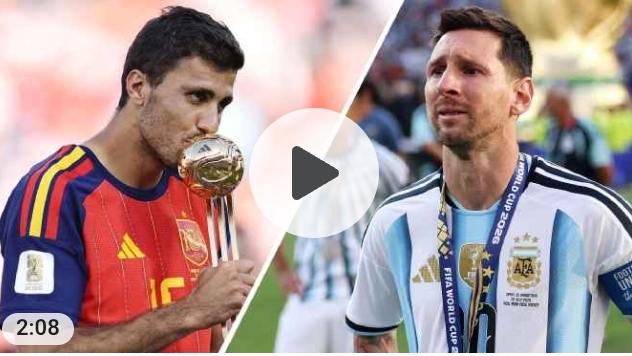
The ‘ESPN FC’ crew debates Rodri vs. Messi for World Cup’s best player
And yet still: Is it the height of abject skepticism to suggest that all the goodwill of this tournament — the matches, the emotions, the beautiful connections formed between teams and cities and fans and visitors — is impossibly colored by the inevitable FIFA grime smeared everywhere? God, no. The grime was excruciating.
Some things, such as the forced match breaks that allowed a sport forever prized for its fluidity to have in-game commercials for the first time, were just naked cash grabs. But the seedier, murkier moments — such as President Donald Trump and the American government working to help U.S. Soccer get its star striker, Folarin Balogun, cleared to play despite receiving an automatic suspension — opened doors that might well be impossible to close.
For some, they cut at the fabric of the game’s trust, an attribute FIFA already struggles to maintain. And it’s impossible to yet know the longer-term impact. Make no mistake: Precedents were set during this tournament, many of which might not be super comfortable for anyone going forward.
This past month was, in true American fashion, an overstuffed diner menu of emotions. There was so much right, so much beauty: the Scots and their love affair with Boston, Kansas adopting the Algerians, Messi and Argentina leaving it so late against everyone, Cristiano Ronaldo scoring in his farewell, Vozinha and Cape Verde rising from nowhere to become the stars of the tournament.
But then, too, there was so much wrong, so much ugliness: the entire Balogun saga; the inane math (and scattered convenient Matchday 3 results) that resulted from advancing eight third-placed teams to the knockout rounds; Iran, currently at war with one of the tournament’s hosts, not knowing when or how their team would travel into the country for its matches; and fan groups pushed out by dynamic ticket pricing where FIFA, naturally, collected commissions on every secondary market sale.
In the end, currency is nearly always the most powerful factor in sports, and it is here, too — for good and evil. The incredible amount of dollars generated by this tournament will help FIFA spread soccer’s gospel to parts of the world that need it. It will also almost certainly ensure that the commercialization of the game, whether through those commercials or halftime shows or an overstuffed, 64-team field, continues unabated.
In the end, all we know for sure is this: However you feel about this particular party and all that went into it — whether you found it gorgeous or garish, astonishing or absurd, cinematic or corrupt — it is impossible to imagine a scenario in which FIFA and the United States don’t partner up to throw another one soon, possibly as soon as 2038. It is, for better and worse, inevitable.
What will be the feeling at the end of that one? Probably something similar to the mix of moods that fans all over the globe feel at the end of this one.
It was amazing. It was awful. And they can’t wait to do it again.