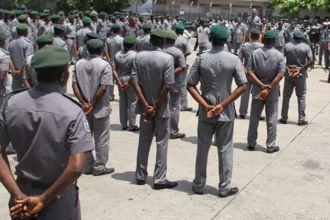

744 repentant terrorists complete rehabilitation
No fewer than 744 former terrorists and victims of violent extremism on Thursday graduated from the Federal Government’s De-radicalisation, Rehabilitation and Reintegration Camp under Operation Safe Corridor.
A breakdown of the 744 clients shows that two are from Abia State, 10 from Adamawa State, one from Akwa Ibom State, two from Anambra State, 12 from Bauchi State, 597 from Borno State, three from Ebonyi State, one from Enugu State, 15 from Kano State, three from Katsina State, one from Kebbi State, five from Kogi State, four from Nasarawa State, two from Niger State, two from Plateau State, two from Sokoto State, and 58 from Yobe State.
In addition, there are foreign nationals, comprising one from Burkina Faso, one from Cameroon, two from Chad, and four from the Niger Republic.
Also, 733 of the graduates are Muslims, while 11 are Christians.
Speaking at the event in Gombe, the Chief of Defence Staff, Gen. Olufemi Oluyede, stated that the initiative is “not a reward” for violence but a strategic tool to curb extremism.
Represented by the Director, Special Operations Forces at Defence Headquarters, Rear Admiral Kabiru Tanimu, he said the programme was designed to address the human dimensions of insurgency and promote lasting peace.
“This moment is not just a ceremony; it is a statement of progress, a demonstration of national resolve and a testimony to the power of strategic thinking in addressing human dimensions of conflict,” he said.
Oluyede stressed that while military force remains necessary, long-term stability depends on rehabilitation and reintegration.
“Operation Safe Corridor represents Nigeria’s firm belief that while kinetic operations are necessary to neutralise threats, lasting peace can only be achieved when we address the underlying drivers of de-radicalisation, disengagement and reintegration,” he said.
He added, “This is not a reward but a deliberate strategy to reduce violence, weaken extremist recruitment and promote long-term stability.”
Addressing the graduates, the CDS urged them to embrace a new path, warning against a return to violence.
“Nigeria is giving you a second chance; do not waste it. You are returning not just to your communities but to a responsibility to live peacefully, to contribute meaningfully and to reject all forms of violence and extremism,” he said.
Oluyede also clarified that the initiative should not be mistaken for amnesty. “Operation Safe Corridor is not an amnesty programme, and it is not a sign of weakness. It complements military operations by addressing the human threats of conflict, reducing recidivism and weakening the ideological foundations of violent extremism,” he noted.
He called on state governments and communities to support the reintegration process, saying, “Reception, monitoring and community acceptance remain critical to sustaining the gains achieved today. This must be a collective effort.”
Earlier, the Coordinator of Operation Safe Corridor, Brig. Gen. Yusuf Ali said the programme was established as a deliberate strategic response to insurgency, combining security efforts with rehabilitation.
“While military operations continue to degrade and neutralise threats, it became evident that lasting peace requires a structured pathway for disengagement, rehabilitation and reintegration of those willing to renounce violence,” Ali said.