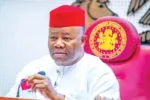
Opposition candidate Paul Hounkpè conceded defeat as the finance minister and outgoing president’s choice candidate swept to victory, according to provisional results announced by Benin’s electoral commission CENA.
Romuald Wadagni, the candidate of the ruling majority in Benin‘s presidential race, has secured 94.05% of the vote, according to the provisional results announced overnight on 13-14 April by the country’s Commission Électorale Nationale Autonome (CENA), based on 90% of ballots counted.
His sole rival, the moderate opposition figure Paul Hounkpè, took 5.95%, with turnout at 58.75%, according to the CENA.
Wadagni succeeds Patrice Talon, who is stepping down after two five-year terms in accordance with the constitution, during which Benin experienced an economic boom but also a rise in jihadist violence in the north and a tightening of public freedoms. On Sunday, as he cast his vote, Talon promised he would not seek “to influence” his successor and that, at 67, he wished to retire.
A foregone conclusion
The final results will be announced by the Constitutional Court. “Voting took place calmly across the entire country,” said Sacca Lafia, the head of CENA, when announcing the results. Turnout appears to have been higher in rural areas than in the country’s two main cities – Cotonou (where an attempted coup took place in December) and Porto-Novo – where polling stations saw relatively low attendance.
Most observers said the outcome was a foregone conclusion, with Hounkpè appearing as a weak opponent against the political machine surrounding Wadagni, who was endorsed by the outgoing head of state and backed by the two parties of the ruling majority.
The main opposition party, Les Démocrates, was absent from the election, having failed to secure the required number of endorsements.
The ECOWAS election observation mission deployed in Benin praised a “peaceful atmosphere” and the “smooth running of the election”. While CENA welcomed a calm ballot, a civil society election-monitoring platform reported incidents on Sunday, including polling stations opening early and some cases where ballot boxes were already filled before voting began.
A technocrat who shuns the spotlight
Wadagni built his legitimacy in numbers before securing it at the polls. After 10 years at the finance ministry, where he was the architect of sweeping economic reforms, he is to become Benin’s president.
From the arrivals hall of the airport to the roundabouts of Cotonou, the country’s largest city, it was impossible in recent weeks to miss Wadagni, smiling behind his round glasses in campaign posters. He travelled across Benin, holding rapid-fire rallies – up to six a day – while emphasising his closeness to ordinary people, despite being a discreet technocrat previously rarely seen in the media and not fond of cameras.
In a relaxed, lecturer-like style – without a tie or a suit – Wadagni delivered speech after speech without notes, covering every topic as if to shed the image of a pure economist that has long defined him. “During this campaign, he showed his true face – he has a personality that is close to people, that is his real nature,” said a member of his entourage.
Architect of fiscal consolidation
Born into a family of intellectuals – his father, Nestor, was a prominent Beninese economist and his mother an entrepreneur – “RoW”, as his supporters call him, was born on 20 June 1976 in Lokossa, in the south-west, near neighbouring Togo. He says he has remained close to his roots and often notes that he owns a farm that he has never lost sight of.
His early career, however, unfolded far from Benin. After studying finance in Grenoble, France, he trained at Harvard before joining the prestigious firm Deloitte, where he became a partner and worked notably on African operations.
In April 2016, just months before Wadagni’s 40th birthday, newly elected president Talon entrusted him with the finance ministry to implement an ambitious programme of economic reforms. Under their leadership, Benin cleaned up its public finances, cutting the deficit by two-thirds to 3% of GDP, launching major infrastructure projects and modernising its economy. In 2021, when Talon was reelected, he renewed his confidence in Wadagni and promoted him to state minister.
Growth has been strong – averaging above 6% over the decade – and international investors have embraced this West African success story. As president, “he will continue along the same path”, says political analyst Franck Kinninvo.
Challenges lying ahead
Wadagni will also have to confront jihadist violence that has hit the army hard in the north of the country. His entourage says that Talon involved him in all major security decisions in recent years and endorsed Wadagni as his successor.
Wadagni represents a new generation of leadership – less about rhetoric and more about impact.