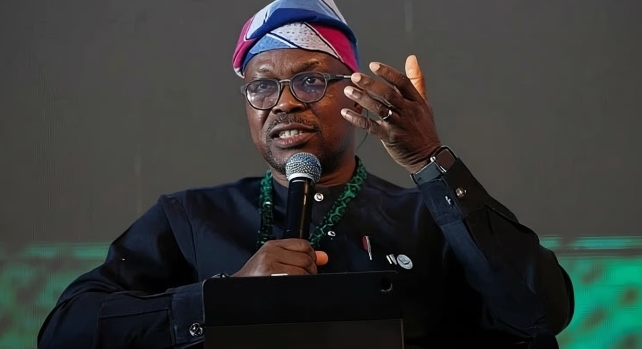
Minister of State for Health and Social Welfare, Adekunle Salako
…Advocates deployment of cutting edge solutions
The federal government has said that Africa faces a serious challenge from the scrouge of cancer which kills more than war and is killing more Africans than AIDS, Malaria and Tuberculosis combined.
Quoating the Global Cancer Observatory (GLOBACAN) data, government noted that Africa recorded 1,187,697 new cancer cases and 721,629 cancer related deaths in 2024.
Minister of State for Health and Social Welfare, Dr Adekunle Salako who stated this at the African Organization for Research and Training in Cancer (AORTIC) and the Best of ASCO Africa 2026 on Friday in Abuja observed that this unacceptable morbidity and mortality figures are largely due to increase prevalence of life style and environmental risk factors, ageing population, non-implementation or near lack of early detection strategies and poor treatment infrastructure exacerbated by health inequities across the continent.
Salako lamented that Nigeria being the most populous nation in the continent accounts for about 10.5 percent of the figure for Africa, sharing the unenviable top 3 positions with Egypt and South Africa.
He noted that the theme of the event, “From Global Discovery to Local Recovery: Driving Africa to the Cutting Edge of Cancer Care,” is apt as it reflects our commitment to translating global oncology advances into context-specific solutions that improve outcomes across Africa.
Salako emphasized that Africa must rise to tackle the cancer burden not just as a health issue, but as a matter of human security, economic progress, and sustainable development.
He noted that politics, security and trade have in the past dominated pan-african conversations ,but time is now to push for more on Healthcare Pan-Africanism to collaboratively tackle African health challenges.
According to him, the opportunity to reframe this burden, transforming it from an escalating fiscal drain into a platform for human capital investment, economic productivity, and health system maturity, is being amplified through events like this that provides an African approach to global oncology breakthroughs.
He said, “The cancer burden is however not an intractable fate, it is a solvable problem as the science of prevention is settled; the policy frameworks are in place and in a number of African countries, including Nigeria the political will is demonstrably stronger than at any previous point in our health governance history. What remains is the pan-African spirit of collaboration, financing architecture that is domesticated and, the institutional will to execute at scale”.
The minister who stated that Nigeria is making steady progress in cancer research, prevention and care with a vision to reduce the cancer burden by at least 30% by 2030, observed that Nigeria is demonstrating resilience backed by the highest level of political support to address challenges in the entire cancer care continuum and has developed and we are vigorously implementing the Nigeria National Cancer Control Plan 2026-2030 with the ambitious goal of reducing cancer burden in Nigeria by 30% by 2030