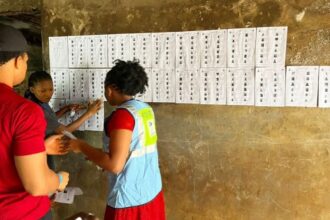

The committee said it would critically examine the proposal before making budgetary provisions in INEC’s 2026 allocation to accommodate preparations for the 2027 general elections.
13 February, 2026
Chairman of the Senate Committee on Electoral Matters, Simon Lalong, has said the National Assembly will determine the amount to be appropriated to the Independent National Electoral Commission (INEC) for the electronic transmission of election results from polling units to the INEC Result Viewing Portal (IReV).
Mr Lalong, who represents Plateau South Senatorial District, said the committee would critically examine the proposal before making budgetary provisions in INEC’s 2026 allocation to accommodate preparations for the 2027 general elections.
He stated this on Thursday when the INEC Chairman, Joash Amupitan, appeared before the National Assembly Joint Committee on Electoral Matters.
“We’ll look into it. It is not INEC that will determine the cost. The committee will look at the issue critically,” he said.
On Tuesday, the Senate rescinded its earlier decision on the Electoral Act amendment, which had rejected the mandatory electronic transmission of election results from polling units to the INEC’s Result Viewing Portal (IREV) after vote counting.
The lawmakers consequently re-amended the Electoral Act to accommodate the electronic transmission of results. However, the provision comes with a caveat that, in the event of internet failure, Form EC8A will serve as the primary means of result collation.
Despite the change, the amendment does not make electronic transmission mandatory. Instead, it allows results to be transmitted electronically while providing an alternative in cases of network failure.
Form EC8A is the primary document on which the presiding officer records the results immediately after votes are counted at a polling unit. In election petitions, courts often rely heavily on EC8A forms because they represent the first official record of votes at the source.
The Senate has constituted a nine-member harmonisation committee to reconcile differences between its version of the bill and the one earlier passed by the House of Representatives.
Harmonisation committee to meet on Monday
Mr Lalong announced that members of the harmonisation committee, drawn from both chambers of the National Assembly, will meet on Monday.
The sitting is expected to be open, with members debating the various provisions of the Electoral Act amendment bill.
One of the key decisions taken during clause-by-clause consideration was the rejection of a proposal to make the electronic transmission of results from polling units to the IReV mandatory after vote counting.
Instead, under Clause 60, the Senate retained the provision in the 2022 Electoral Act that allows election results to be transmitted to the collation centre.
On voter identification under Clause 47, the lawmakers rejected a proposal to allow alternative means of identification for voting aside from the Permanent Voter Card (PVC). Instead, they replaced “smart card readers” with the Bimodal Voter Accreditation System (BVAS) for accreditation and voting, thereby retaining the PVC as the sole mandatory means of identification at polling units.
Initially, the bill had proposed that since BVAS does not read the microchip embedded in PVCs, the card should no longer be compulsory for voting, allowing the use of the National Identification Number (NIN), Nigerian passport, or birth certificate. However, the Senate disagreed with this proposal and retained the PVC as the primary mode of voter identification.
On Clause 22, which prescribes penalties for PVC-related offences, lawmakers rejected a proposed 10-year jail term for the buying and selling of PVCs. Instead, they retained the two-year imprisonment term and increased the fine from ₦2 million to ₦5 million.
Regarding proof of non-compliance, the Senate deleted Clause 142, which would have allowed parties to prove non-compliance solely through original or certified documents without oral evidence. The lawmakers, during the clause-by-clause consideration, argued that the provision would amount to a “waste of time in court.”
On ballot paper inspection, Clause 44 retained the existing procedure, which gives political parties two days to submit written approval or disapproval of their representations on sample ballot papers. INEC is also required to invite parties to inspect sample electoral materials at least 20 days before an election.
Under Clause 29, the deadline for political parties to submit their list of candidates was reduced from 120 days to 90 days before the election.
To curb vote buying, the lawmakers amended Clause 22 to impose stiffer penalties, increasing the fine for offenders from ₦500,000 to ₦5 million.
On post-election disputes, the Senate amended Clause 136 by removing the power of election tribunals to declare winners outright in certain circumstances. The amendment now provides that, where a candidate is found not to have been validly elected for failing to secure a majority of lawful votes, a rerun election shall be conducted, with the disqualified candidate and the sponsoring party barred from participating.
This section contradicts the provision of the 2022 Electoral Act, which provides that where an election tribunal nullifies an election on the ground that the candidate with the highest votes was not qualified, the candidate with the second-highest number of valid votes should be declared elected.