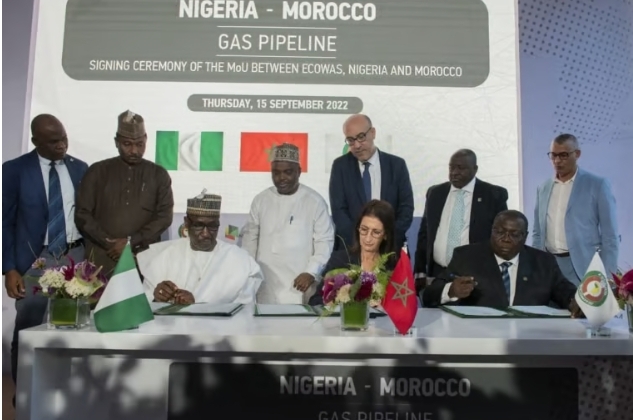
Amina Benkhadra, director general of Morocco’s National Office of Hydrocarbons and Mines, Sediko Douka, representing Ecowas, and NNPC chief executive Mele Kyari after signing a memorandum of understanding on the construction of the Nigeria–Morocco gas pipeline in Rabat on 15 September 2022. © Jalal Morchidi/Anadolu Agency/Anadolu via AFP
The Nigeria–Morocco gas pipeline, known as the NMGP, will stretch for about 6,000km and cross 13 countries along Africa’s Atlantic coast.
The heads of state of the Economic Community of West African States (ECOWAS) signed an intergovernmental agreement approving the construction of the gas pipeline linking Nigeria and Morocco on Sunday 19 July. The agreement was signed during the regional organisation’s ordinary summit in Freetown.
It is designed to carry billions of cubic metres of Nigerian gas to Morocco, where it will connect to the Maghreb–Europe gas pipeline
‘Do not be surprised when the gas reaches you’
“We have signed the agreement on the West Africa–Morocco gas pipeline. Do not be surprised when the gas reaches you,” said ECOWAS chair Julius Maada Bio, the president of Sierra Leone, in a speech.
The pipeline aims “to connect West Africa’s gas resources to the region’s main centres of consumption, while strengthening the integration of African energy markets and creating a new development corridor linking West Africa, the Sahel states, Morocco and Europe”, according to a joint statement by Morocco’s Office National des Hydrocarbures et des Mines (ONHYM) and the Nigerian National Petroleum Corporation (NNPC).
“This important step taken in Freetown comes ahead of the next stages of the project’s launch,” the statement said. These will include setting up a project company based in Casablanca and a Pipeline Higher Authority headquartered in Abuja, before investors are brought in and preparations begin for a final investment decision.
Construction is expected to begin in 2028, with the first gas deliveries scheduled for 2031, according to a source at ONHYM.
A €23bn project
“The African Atlantic gas pipeline will make a lasting contribution to strengthening energy security, accelerating industrialisation, supporting the development of Africa’s natural resources and promoting shared prosperity,” said Amina Benkhadra, ONHYM’s director general.
King Mohammed VI first proposed the project in 2016 during a visit to Abuja intended to strengthen Morocco’s partnerships with African countries.
The project gained fresh momentum after Algeria – Africa’s largest natural gas exporter – ended the contract for the Maghreb–Europe gas pipeline in 2022. The pipeline had carried Algerian gas to Spain through Morocco. Algeria took the decision after breaking off diplomatic relations with Rabat.
The NMGP also comes against a geopolitical backdrop shaped by the surge in hydrocarbon prices since Russia’s invasion of Ukraine. The giant pipeline is expected to cost an estimated €23bn.