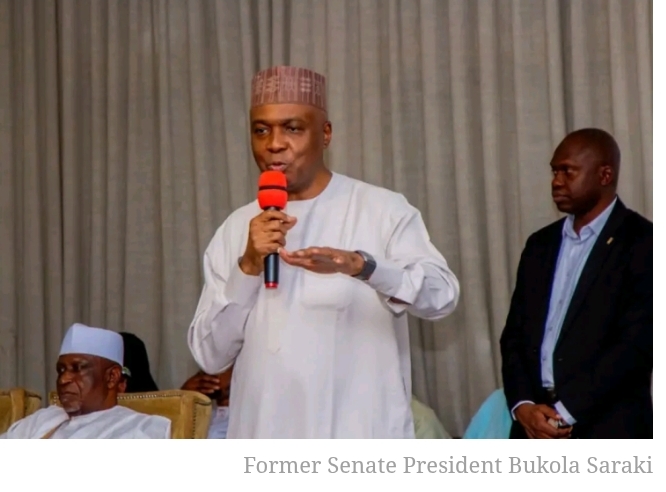
Federal legal advice clear Bukola Saraki as fresh charges revive Offa robbery case
Fresh legal and political disputes have emerged over the 2018 Offa bank robbery following new charges filed by the Kwara State Government, despite federal legal advice clearing former Senate President Bukola Saraki of any involvement.
The Office of the Attorney-General of the Federation had, in 2018, found no evidence linking Mr Saraki to the deadly robbery, which involved attacks on banks and a police station and left at least 32 people dead, including nine police officers.
Legal advice
The legal advice, issued on 22 June and 23 August 2018 by the Director of Public Prosecutions of the Federation (DPPF), Mohammed U.E., followed a police investigation into the incident.
In the documents addressed to the Inspector-General of Police, the DPPF stated that there was no evidence connecting Mr Saraki to the crimes.
It said it was “unable to establish from the evidence… a nexus between the alleged offence and the suspects,” a position it maintained in a subsequent review, concluding that no prima facie case existed against him for charges including criminal conspiracy, armed robbery and culpable homicide.
The DPPF instead identified six principal suspects, including Ayo Akinnibosun, against whom it found sufficient evidence to prosecute.
Those suspects were later tried and convicted.
The legal advice also found no collaborative evidence linking Yusuf Abdulwahab, then Chief of Staff to the governor, to the robbery, while recommending a separate firearms charge against another aide.
According to the documents, the offences fell within the jurisdiction of the Kwara State High Court, prompting a directive that the case file be transferred to the state attorney-general for prosecution.
Interestingly, the legal advice from the office of the Attorney-General of the federation was given at a time Mr Saraki was the de facto leader of the opposition in the country.
Although elected senator on the ticket of the ruling All Progressives Congress (APC), he quickly fell into disaffection with the leadership of the party when he worked with opposition senators to defeat the favoured candidate of the ruling party in the race for the president of the Senate.
He later defected alongside many other senators and his followers in Kwara, including Governor Abdulfatah Ahmed, to the Peoples Democratic Party, where he made an unsuccessful bid to return to the Senate in 2019.
Court rulings
According to judgements delivered on the matter, the Kwara State High Court convicted the principal offenders after a protracted trial, a decision later upheld by the Court of Appeal sitting in Ilorin in January 2026.
The appellate panel, led by Justice Ridwan Abdullahi, and including Justices Gabriel Kolawole and Abdul Dogo, affirmed the death sentences imposed on the convicts, holding that the prosecution proved its case beyond reasonable doubt.
The court upheld the convictions of Ayoade Akinnibosun, Niyi Ogundiran, Ibikunle Ogunleye, Adeola Abraham, and Salawu Azeez for armed robbery, illegal possession of firearms and culpable homicide.
The matter is now before the Supreme Court.
it was reported on Tuesday that the Kwara State Government filed a fresh 20-count charge against Mr Saraki, former governor Abdulfatah Ahmed, and two others.
The charge, filed under case number KWS/114C/26, accuses them of criminal conspiracy and culpable homicide, alleging that they armed suspects involved in the 2018 robbery.
Those listed alongside them include Mr Abdulwahab and a former aide, Alabi Olalekan. They are expected to be arraigned before Justice Haleemah Salman of the Kwara State High Court on 4 June.
The charges follow the Court of Appeal’s affirmation of earlier convictions connected to the robbery, including Ayo Akinnibosun, who allegedly confessed during trial to being a hitman within a political network.
According to the state government, weapons and other exhibits linked to the crime were recovered from the Government House and a state ministry in 2018 and later tendered in court as evidence during the trial of the principal suspects.
Prosecutors also rely on confessional statements attributed to Akinnibosun, who allegedly claimed he led a group of armed operatives connected to political figures and received financial and logistical support.